
Karnataka and Andhra Pradesh announce ban social media for teens, sparking debate about its effectiveness, impact on education, and implications for advertisers targeting young audiences.

In the June quarter of 2024-2025, smartphone exports hit $2 billion, well ahead of non-industrial diamond exports, which stood at $1.44 billion.

The reason is because there aren't any screens for a large mass of Indians.

GenAI smartphones are mobile devices that leverage large-scale, pre-trained GenAI models to create original content or perform contextually aware tasks.

Karnataka Chief Minister announces a ban on social media for children under 16 and increased measures to prevent drug abuse in schools, colleges, and universities, alongside investments in education infrastructure and mental health support.

With the music industry pushing for growth in the paid subscription segment, Universal Music India anticipates that the Indian market will mature, potentially becoming a highly impactful paid market for music over the next five years.

Even if 5G is not launched by operators this year, the handsets market will certainly witness a strong supply ecosystem for 5G ready smartphones in 2021.

South Korean consumer electronics major Samsung, which on Wednesday launched its latest smartphone Galaxy S25 in San Jose, US, will also be manufacturing it at its Noida plant in India, J B Park, president & CEO of Samsung Southwest Asia, said. Moreover, the Bengaluru-based R&D centre of Samsung, the biggest outside South Korea, has "contributed significantly" for developing the S25 series of Galaxy AI.

India and the European Union are set to announce on January 27 the conclusion of negotiations and finalisation of a free trade agreement, which is aimed at boosting economic ties between the two regions amid disruptions in global trade due to US tariffs, an official said.

India and the European Union (EU) on Tuesday announced the conclusion and finalisation of negotiations for the proposed free trade agreement (FTA).

The report, "Smartphone forecasts and assumptions, 2007-2020", prepared by GSMA Intelligence, finds that smartphones presently account for one in every three mobile connections, representing more than two billion connections.

Apple's iPhone Pro Max 17 in cosmic orange has witnessed a considerable surge in demand, and it has gone out of stock within three days after pre-booking went live for pick up of the devices at the company's official stores in the US and India, as per information shared by company staff.

'Look at what kind of sites the child is visiting, what kind of games they are playing and then tell them about the pitfalls.' 'After the child sleeps, parents can check the history of sites visited and block sites that could be dangerous or inappropriate.'

'BSE has facilitated nearly Rs 35 trillion in capital raising across multiple segments.'

All the BSE sectoral indices closed in the green. BSE Realty, Auto, Capital Goods and Industrials were lead gainers, jumping up to 5 per cent. IndusInd Bank was the lead gainer among Sensex shares, surging by 6.84 per cent. Tata Motors rallied 4.50 per cent. Larsen & Toubro, Axis Bank, Adani Ports, HDFC Bank, ICICI Bank and HCL Tech were also among the gainers. ITC and Hindustan Unilever were the only laggards.

Realme has introduced a brand-new 5G handset in the Indian market, designed for value-seeking buyers who want smooth performance without worrying about frequent recharging.

Smartphones have been a key success story of the government's production-linked incentive scheme, helping India become the second-largest mobile phone manufacturing country, after China.
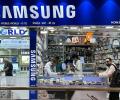
As many as 37 per cent of smartphones sold in India in 2022 cost Rs 15,000 or more.

LG is targeting a turnover of Rs. 3,000 crore in 2011 and sell 450,000 smartphone units in India this year.
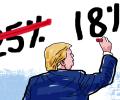
'Trump says India will buy over $500 billion of US goods.' 'At present, India's annual imports of goods and energy from the US are under $50 billion.' 'Reaching $500 billion would likely require more than 20 years, suggesting the figure refers to a long-term aspiration rather than a near-term commitment.'

The Indian AI market is expected to grow to over $17 billion by 2027, more than tripling its current size, driven by increased investments in enterprise technology, a flourishing digital ecosystem, and a strong pool of skilled professionals, according to BCG.

The Uttar Pradesh government and iPhone maker Foxconn have started discussions to set up an electronics manufacturing unit in the state, sources aware of the development said. The investment pitch was made by Invest UP to Foxconn at the time of the final land allocation for the HCL-Foxconn chip joint venture Vama Sundari.

Targeted at fast growing low-cost smartphone markets like India, Nokia launched the much anticipated Android-based smartphones starting at Rs 7,600.

Market grew 15% YoY in June quarter, sharply lower from 23% in previous quarter and 34% in the same quarter of 2015
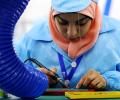
In 2023, the share of US electronics imports from India was a mere 1.9 per cent of the $520 billion they imported, while the total Indian electronics exports to the US was pegged at only $10 billion.

India will have 1 billion smartphone users by 2026 with rural areas driving the sale of internet-enabled phones, a Deloitte study said on Tuesday. India had 1.2 billion mobile subscribers in 2021, of which about 750 million are smartphone users. It is poised to be the second-largest smartphone manufacturer in the next five years. "The smartphone market is expected to reach 1 billion smartphone users by 2026," according to Deloitte's 2022 Global TMT (Technology, Media and Entertainment, Telecom) predictions.
Domestic handset maker Intex has launched India's first Firefox OS based handset for Rs 1,999, targetted at capturing a larger chunk of the booming affordable smartphone market in India.

The first half of the year (H1-2020) was marked by sluggish growth with demand down 26 per cent YoY, while the second half saw recovery. H2-2020 recovered with 19 per cent YoY growth, reports Shivani Shinde.

Russian President Vladimir Putin's visit to India this week aims to secure energy supplies, stabilise defence deliveries and ensure bilateral trade continues smoothly despite strong Western sanctions, GTRI said on Tuesday.
The growth of Chinese manufacturers is shaking up the smartphone industry.

Among the top five vendors, Micromax (18 per cent) and Lava (54 per cent) were the only ones to have outstripped the market growth.

China's Vivo said on Thursday it will export more than one million 'Made in India' smartphones in 2023 to achieve a target announced last year when it sent out its first indigenous shipment to Thailand and Saudi Arabia. Vivo India, known for its economical phones, has proposed investing Rs 7,500 crore in the country and it is set to spend Rs 3,500 crore of that amount by end of this year. According to the firm's India Impact Report 2022, it will start production at a new 'state of the art' manufacturing facility by early 2024 after regulatory clearance.

The top 5 cities of India made up about 60 per cent of the online smartphone sales in India.

'We are increasing our footprint, but other markets also compete - like Indonesia or Vietnam.'

'Calibrated depreciation will help rebalance external fundamentals, offset some of the tariff differentials with competitors, improve the competitiveness of domestic substitutes vis-a-vis Chinese imports, and contribute to the easing of financial conditions at a time when the inflation rate is unusually low,' explains Sajjid Z Chinoy, head of Asia Economics at JP Morgan.

India has pipped China to drive the volume growth of smartphones in the world on the back of falling prices of high-end devices.

Can the launch of smartphones under its own brand name by Finnish company HMD Global - despite having a licence to use the Nokia brand which it bought from Microsoft - help it regain its once dominant position in the mobile phone sweepstakes in India, where it was once routed? In 2009, Nokia was the country's largest MNC with revenues of $4 billion and a market share touching 80 per cent in 2010. After this, its fortunes fell. Although it had been the first global player to set up an assembly plant, not only to assemble phones for the local market but for exports, it had to shut down operations in 2014.
There are plenty of smartphones under Rs 30,000 but these are the top five across all major smartphone platforms.

In spite of being attacked from all corners, a faltering supply chain and negative sentiments soaring high among the local consumers, top Chinese smartphone brands gained market share during the most critical phase - the April-June quarter of this year.

It has captured 38 per cent of the feature phone segment in 2018 through frequent innovation, says Arnab Dutta.
